 Flagler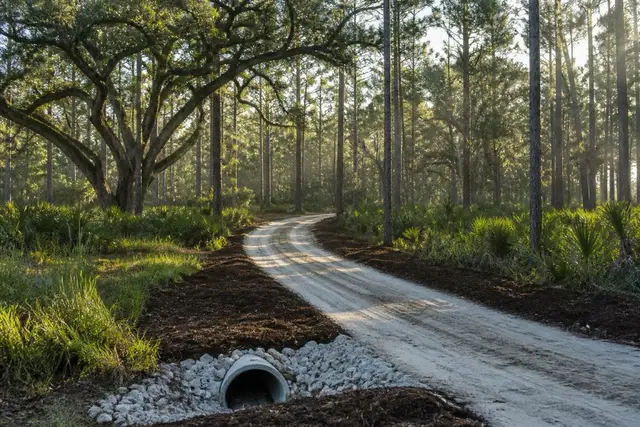
Flagler Clearing Pros connects Palm Coast property owners with a local land clearing contractor for access road & driveway clearing in Palm Coast and the Flagler County communities around it.
Plenty of Flagler County land is owned but not reachable. Acreage in Daytona North, wooded parcels off the county's dirt grid, and deep flag lots in the plat maps all share the same first problem: no way to get a truck, a well rig, or eventually a concrete mixer from the road to the build spot. Access clearing cuts that route — a corridor wide enough for equipment, cleared of stems, stumps, and overhang, and shaped to stay passable after rain.
A usable drive through flatwoods is built, not just cleared. The corridor gets mulched or grubbed, high spots knocked down and soft spots filled, and the running surface crowned so water sheds to the sides instead of standing in the wheel path. Where the route crosses a ditch or swale — and in this county's drained-flatwoods geography it usually does — a properly sized culvert goes in rather than a rut through the flow line.
Width deserves one honest sentence: a car needs ten feet, but the concrete truck, the well driller, and the septic contractor who follow all appreciate twelve to fourteen with trimmed vertical clearance, and cutting it once beats widening it twice. Curves get swung wide for trailer tracking, and the entrance apron off a dirt road gets extra base so the turn-in doesn't churn to mush.
For rural owners the finished product changes what the land is worth doing anything with — surveyable, showable, buildable, huntable. And because the corridor is narrow relative to a full clearing job, it is one of the more affordable ways to put big equipment productively on raw ground.
Culverts, ditches, and staying legal at the entrance
The point where a new drive meets a public road is regulated ground. County-maintained roads want a proper driveway connection — culvert sized to the ditch's flow, apron built so the road edge doesn't break up — and the county's road-and-bridge side is the authority on what a legal connection looks like on its rights-of-way. Inside city limits the City of Palm Coast handles the equivalent on its streets. Skipping the culvert is the classic false economy: the first wet season either floods the ditch upstream or washes the entrance out.
On private interior runs the same physics apply without the paperwork — every ditch or wet-weather flow the route crosses is a place water must keep moving under the drive, not around it.
Building a surface that survives the wet season
Native flatwoods sand makes a fine dry-season road and a poor July one. The seasonal water table under Myakka-type soils rides high in summer, and loaded tires quickly pump soft spots into holes. The fixes are old road-builder arithmetic: crown the surface, keep side drainage open, lift low segments with compacted fill, and armor the running course with shell, crushed concrete, or graded rock where traffic will be regular.
Owners planning a build should tell the contractor what's coming down the drive — a route that will carry concrete trucks and a crane for one intense month gets built to a different standard than a weekend camp track, and it is far cheaper to specify that up front than to rebuild after the first wet spell finds the weak segments.