 Flagler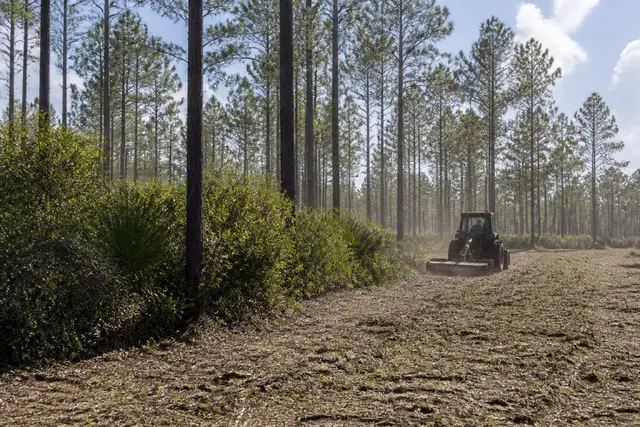
Flagler Clearing Pros connects Palm Coast property owners with a local land clearing contractor for brush & underbrush clearing in Palm Coast and the Flagler County communities around it.
Flatwoods understory does not sit still. Give a Flagler County parcel five unattended years and the space between the pine trunks fills with gallberry, wax myrtle, grapevine, and palmetto until you cannot see thirty feet into your own land. Underbrush clearing takes that mid-story out — with a bush hog on lighter growth or a mulcher on woodier thicket — and gives the parcel back its sightlines while every canopy tree stays rooted.
The result changes how the land works. A walkable pine understory means you can actually inspect fence corners, find the survey monuments, spot a leaning dead snag before a storm drops it, and let kids or dogs roam without wading through tick habitat. For acreage owners west of town, it is also the difference between land you use and land you only own.
There is a fire-safety angle that Florida owners learn quickly. Continuous brush running up to a house is exactly the ladder fuel that lets a fast-moving wildfire climb; this county's flatwoods burned hard in past drought years, and thinned understory around structures is a standard piece of defensible-space practice. Clearing the brush band around a home does not fireproof anything, but it removes the fuel that does the most damage.
Scheduling is flexible because the work is repeatable. Some owners clear once before a sale or a build; others put their acreage on a standing cycle — every year for mowed pasture edges, every two to three for mulched flatwoods — so the growth never gets ahead of the budget again. A written quote can price either pattern.
Reading flatwoods growth before you cut it
Not everything green in the understory is a problem. Native gallberry and palmetto rebound harmlessly; what deserves a harder look is the exotic component — Brazilian pepper, camphor, cogongrass — that regrows faster than natives and shrugs off a plain mowing. The UF/IFAS Center for Aquatic and Invasive Plants keeps profiles of the usual offenders, and a contractor who can tell myrtle from pepper at twenty feet will sequence the job so the invasives get treated, not just trimmed.
Wildlife matters too. Dry, sunny openings in this county's sand are prime gopher tortoise ground, and their burrows — protected by state rule — often hide under exactly the palmetto clumps a machine is about to hit. The FWC's gopher tortoise pages explain the 25-foot standoff; a pre-cut walk marks any burrows with flagging so the machine steers around them legally.
Bush hog, mulcher, or hand crew — matching the tool to the thicket
Light, leafy regrowth under two inches of stem falls fastest to a rotary cutter behind a tractor — cheap per acre, clean finish, best where the ground is smooth enough to mow. Woodier thicket with saplings and mature palmetto wants a drum mulcher that grinds rather than whips. Tight corners against fences, sheds, and screened pool cages get finished by hand with saws and loppers, because no sensible operator swings a machine within feet of aluminum framing.
Weather sets the calendar more than most owners expect. The Jacksonville forecast office covers this county for a reason — summer brings near-daily convection, and a mowed finish looks dramatically better when the ground was dry enough not to rut. Late fall through spring is prime cutting season here, with growth dormant and the sand firm.