 Flagler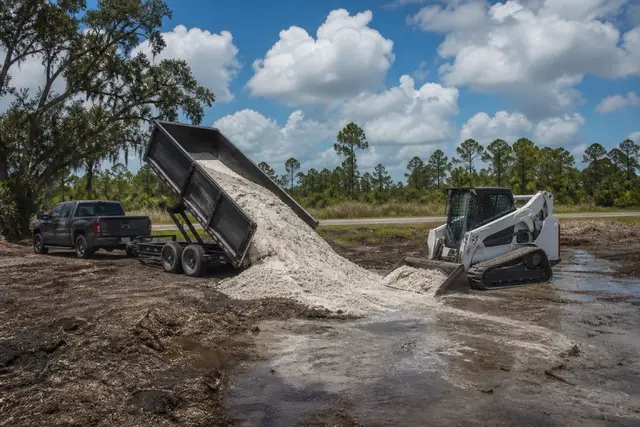
Flagler Clearing Pros connects Palm Coast property owners with a local land clearing contractor for fill dirt services in Palm Coast and the Flagler County communities around it.
Flagler County is flat, and flat ground argues about inches. A lot that sits a foot low relative to its neighbors collects their runoff every June; a backyard corner over an old depression stays spongy long after the rain quits; a building pad that isn't lifted above the street's wet-season line invites water to the slab. Fill dirt is the blunt, effective answer — clean material trucked in, placed where the ground is losing the argument, and compacted until it holds elevation.
Not all fill is the same word. Clean sand fill is the workhorse here — local, affordable, drains well, compacts predictably. Stabilizing material with more fines suits road base and entrance aprons. Topsoil is a finishing layer for lawns, not a structural lift. A quote that just says "fill" without naming the material and the compaction method is leaving the two most important facts blank.
Placement is where the craft lives. Dumped piles pushed around once will settle unevenly for years; proper work spreads the material in lifts, compacts each course, and feathers the new grade into the old so the transition doesn't read as a ramp. Around trees that are staying, fill stays off the root flare — burying a live oak's trunk collar is a slow-motion removal order.
The one thing fill must never do is solve your water problem by creating the neighbor's. Raising grade changes where runoff goes, and the design has to keep discharge on your parcel's approved path — toward the swale, not across the fence. That's a rule of neighborly physics and, inside the city, of the drainage system the plat was engineered around.
How many loads: the arithmetic owners actually need
Fill math is simple enough to sanity-check any quote: length times width times depth of lift, divided by 27, gives cubic yards, and a standard dump load delivers somewhere in the teens of yards depending on the truck. Lifting a 2,000-square-foot low area half a foot is therefore roughly 37 yards — call it three truckloads — before compaction losses, which add a real percentage on loose sand. The USDA Web Soil Survey shows what your parcel's native profile is, which is worth a look before deciding how much of the problem is elevation and how much is drainage.
Delivered price varies with haul distance from the pit, so jobs near active mines quote better than far-flung acreage — one reason local contractors with local sources tend to beat brokered material.
Where fill is not the answer
Two boundaries matter. First, wetlands: low ground that holds water may be jurisdictional, and filling a wetland without the required state and federal authorization is the kind of mistake that gets unwound at the owner's expense — when a soggy area looks less like a puddle and more like a system, the question goes to the state's environmental-permitting side before any truck rolls. Second, the drainage plat: inside Palm Coast, swales and flow lines are engineered infrastructure, and the city treats private fill that blocks them accordingly.
Neither boundary comes up on most residential lifts — a low lawn corner is just a low lawn corner. But a contractor who asks about standing water, plat drainage, and what's downhill before quoting is demonstrating exactly the judgment the job needs.