 Flagler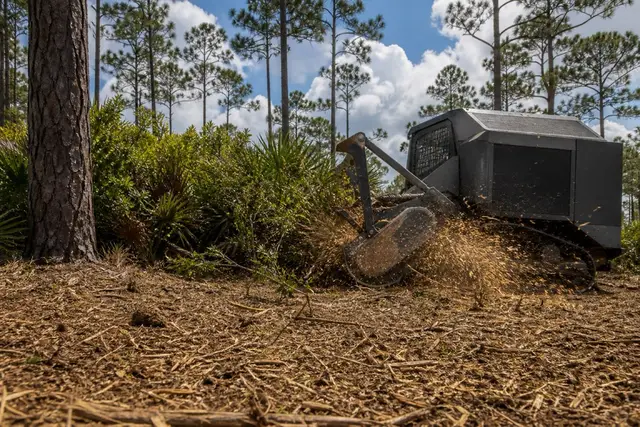
Flagler Clearing Pros connects Palm Coast property owners with a local land clearing contractor for forestry mulching in Palm Coast and the Flagler County communities around it.
Around Palm Coast, forestry mulching earns its keep on a specific kind of parcel: the wooded quarter-acre that ITT platted fifty years ago and nobody ever built on. A tracked carrier with a drum head crawls onto the lot, works through chest-high saw palmetto, gallberry, wax myrtle, and pine saplings, and leaves behind a level carpet of ground wood instead of a scarred sandbox. One machine, one pass, and the lot reads as maintained instead of abandoned.
What the method avoids matters as much as what it does. Burning brush in Florida comes with Forest Service rules on pile size, setbacks, and attendance, plus dry-season bans that can idle a job for weeks. Hauling the same material means loader time, truck loads, and disposal fees stacked on top of the cutting. Mulching converts the vegetation where it stands, so neither the burn rulebook nor the dump invoice ever enters the picture.
The chip layer also protects the ground it came from. Most of this county sits on Myakka fine sand — loose, gray, and quick to wash or blow once bare. A few inches of shredded palmetto and pine hold that surface together through the summer thunderstorm pattern, shade out the first wave of regrowth, and rot down into organic matter this sand badly needs.
Honest local pricing has a wide band. Florida mulching work commonly runs a few hundred dollars per acre for light brush up to a few thousand where growth is dense or the ground is soft, and small-lot jobs carry a minimum fee because the machine costs the same to deliver either way. The variables that move the number — density, stem size, access, moisture — are all visible on a walk-through, which is why quotes here start with one.
Why mulching beats burning in Flagler County
Open burning of land-clearing debris is not a casual act in this state. The Florida Forest Service requires authorization for larger piles, and even small yard-waste fires must observe setbacks — well back from wildlands, roads, and neighboring homes — under rules the Florida DEP lays out for open burning. In a spring dry spell, county-wide burn bans can arrive on short notice and park a debris pile indefinitely.
A mulcher makes the whole question moot. Nothing leaves the lot and nothing is lit, so a job scheduled for Tuesday happens on Tuesday whether or not the drought index spiked over the weekend. On the tight street grids of Palm Coast's letter sections, where a neighboring house may stand thirty feet from the property line, skipping smoke altogether is also simple courtesy.
What the machine leaves behind on Myakka sand
Florida named Myakka fine sand its state soil, and it underlies flatwoods across this county: deep gray sand, poorly drained, with a hardpan layer below. Strip it bare in June and the afternoon storms tracked by NWS Jacksonville will cut rills through it before the month is out. The mulch blanket is the countermeasure — it takes the raindrop impact, slows sheet flow toward the swale, and keeps the lot from shedding sand onto the street.
Expect the finished surface to sit a few inches deep in chips, walkable immediately and mowable within a season or two as the material settles. Where a future slab or driveway is planned, say so up front: that footprint gets grubbed and ground clean instead of mulched, so organics never end up under something structural.