 Flagler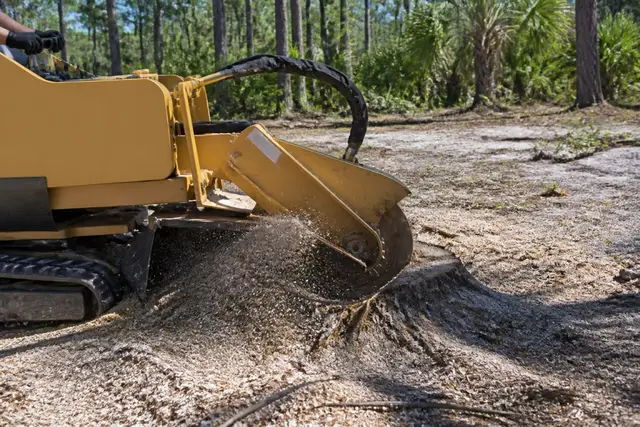
Flagler Clearing Pros connects Palm Coast property owners with a local land clearing contractor for stump grinding in Palm Coast and the Flagler County communities around it.
Every cleared pine leaves a decision in the ground. A slash pine stump in Flagler County sand can sit for a decade, sprouting fungus, feeding insects, and slowly hollowing into a soft spot — or a grinder can erase it in twenty minutes. Stump grinding is the finishing trade of land clearing: a toothed wheel chews the stump and its upper root flare into chips, well below the surface, and the hole gets backfilled with clean material.
Depth is the specification that matters. A cosmetic grind a few inches down is fine under future turf; anything structural — slab, driveway, shed, pool deck — wants the stump ground deep and the organics dug out of the footprint entirely, because buried wood decays, and decayed wood settles whatever sits on top of it. A quote worth signing states its grind depth in inches, not adjectives.
Palm Coast's building history makes this more than fussiness. These flatwoods lots were pine forest within living memory, and lots cleared carelessly in earlier decades occasionally reveal old buried stumps during renovations — discovered as a dip in a driveway or a soft corner of lawn. Grinding done right, with chips removed from any load-bearing footprint, is how a lot avoids becoming that story.
The machines scale to the job: compact pedestrian grinders slip through gates for a single backyard stump, while tow-behind and tracked units clear a whole lot's worth after tree removal. Access, stump diameter, and count set the price, and batching — grinding every stump in one mobilization — is meaningfully cheaper than calling the machine back twice.
What happens under the surface after grinding
A ground stump is not a removed root system — the lateral roots stay in the sand and decay over several years. Under lawn, that is harmless; the decay is slow, and the county's sandy profile drains too fast for the soggy rot pockets that clay soils develop. What the leftover roots will not do is resprout: slash pine dies with its stump, unlike laurel oak or camphor, which can sucker from live roots and occasionally need a follow-up cut or targeted treatment described in UF/IFAS extension guidance.
The chips themselves make honest mulch for beds and paths, but they should never be reused as fill under anything structural, and mixed chip-and-sand spoil belongs off the pad footprint entirely.
Grinding around utilities, slabs, and pool cages
Grinder wheels and buried infrastructure do not negotiate, so the pre-work is non-optional: a locate call to Sunshine 811 for utilities near any stump close to the front of the lot, and a careful look at irrigation runs, low-voltage lighting, and the footers of screened enclosures before the wheel spins. Palm Coast's letter-section lots typically carry service lines along the street frontage — exactly where mature pines were often left standing when houses were built.
Close-quarters stumps beside slabs and cages get worked with smaller machines and shallower angles, trading speed for control. Ask how the operator handles the last foot next to concrete; the good ones have a specific answer, and it usually involves hand tools. General storm-hardening context for trees near structures is covered well by NWS Jacksonville's severe-weather resources.