 Flagler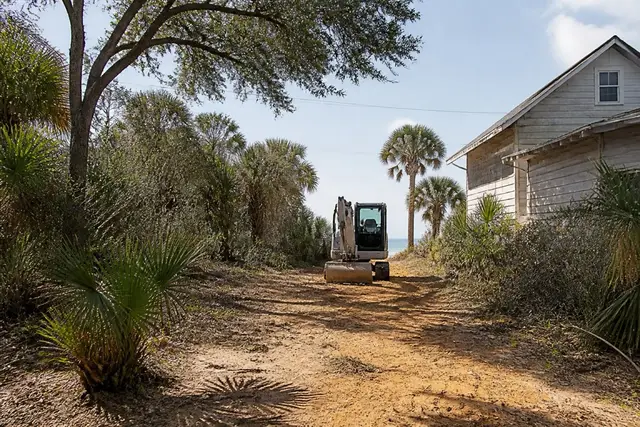
Flagler Clearing Pros connects Flagler Beach property owners with a local land clearing contractor for forestry mulching, lot clearing, and site prep across the Flagler Beach area.
Flagler Beach is the county's old-Florida beach town — 5,160 residents at the 2020 census, wood-frame cottages and low block houses on compact lots between the Intracoastal and the cinnamon-colored coquina sand that makes this shoreline unmistakable. Clearing jobs here are rarely about acreage; they're about salt-toughened overgrowth on small parcels, and about the storm cleanup this stretch of A1A has learned to expect.
Coastal vegetation cuts differently. Salt wind shears scrub oak, wax myrtle, and palmetto into dense, interlocked mats that hold far more material per square foot than inland brush of the same height, and compact machines matter because lots are tight and neighbors are close. The flip side is friendly ground: well-drained sand that carries equipment cleanly nearly year-round.
The dune line is the boundary that governs everything east of the road. Beach dunes and their vegetation are protected as the town's storm armor — recent hurricanes have repeatedly chewed the dune face and even collapsed sections of A1A here — so clearing on ocean-side parcels stays landward of the dune system and leaves sea oats and dune cover strictly alone. A contractor who works this town treats that line the way surveyors treat a corner pin.
Why the dune line is off the table
Flagler Beach's dunes have absorbed the county's hardest storm lessons — Hurricane Matthew in 2016 stripped the dune face and broke sections of A1A, and Nicole in 2022 did it again, with the state trucking in sand by the thousands of yards to reopen the road. That history is why dune vegetation is treated as infrastructure: work stops at the landward edge of the dune system, period. Storm-risk context lives at the National Hurricane Center, and the City of Flagler Beach is the authority on what its coastal parcels may and may not touch.
Small-lot work between the ocean and the Intracoastal
The town's blocks are narrow, so the craft is logistics: a compact tracked machine in through a single gate width, cut material processed on site instead of windrowed across a neighbor's frontage, and the job wrapped in a day so the street stays livable. Overgrowth here often hides Brazilian pepper, which loves disturbed coastal ground; identification resources at the UF/IFAS invasive plant center show why the pepper fraction gets cut-and-treated rather than just mowed, so it doesn't own the lot again in three years.