 Flagler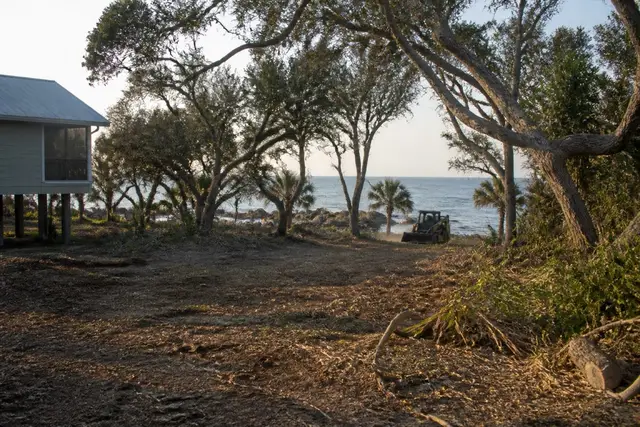
Flagler Clearing Pros connects Marineland property owners with a local land clearing contractor for forestry mulching, lot clearing, and site prep across the Marineland area.
Marineland is one of Florida's strangest and smallest towns — 15 residents at the 2020 census, less than half a square mile straddling the Flagler–St. Johns county line, and a history that begins with the 1938 opening of Marine Studios, the world's first oceanarium. Clearing work at this end of the county is correspondingly particular: small, deliberate jobs on coastal parcels where the setting is the entire point.
The land here is shaped by rock and salt. Coquina outcrops meet the Atlantic along this stretch, salt wind sculpts the oaks into leaning canopies, and the vegetation between structures runs to tough maritime scrub. Clearing is selective by default — overgrowth cut back from buildings and access ways, sculpted character trees preserved, and the shoreline itself left to the forces that made it.
Work around Marineland also means working near protected and research-oriented coastline, with conservation lands close on every side. The practical consequences are ordinary but non-negotiable: tight scopes, clean debris handling, no disturbance beyond the flagged envelope, and a contractor who treats the county line — and the different rules on each side of it — as part of the job's paperwork.
Clearing beside conservation coastline
The Marineland stretch sits amid some of Northeast Florida's most carefully watched shoreline — research facilities, preserves, and public lands share this coast, and the surrounding waters and hammocks are managed as a connected system. For a clearing job that means the envelope is everything: scopes drawn tight, machines kept to flagged ground, and vegetation at the parcel's wild edges feathered rather than walled. Wildlife rules travel with the work as they do everywhere in Florida — the FWC's species guidance covers the tortoises and shorebird considerations this coast is known for.
Two counties, one town
Marineland's municipal boundary crosses the county line, so identical-looking parcels a few hundred feet apart can answer to Flagler County on one side and St. Johns on the other — different permitting offices, different processes, same salt wind. Sorting that out is a five-minute records check a local contractor does before quoting, not a surprise anyone should meet mid-job. The town's double-digit population is a genuine census figure, and the forecast that matters for its exposed coast comes from NWS Jacksonville.