 Flagler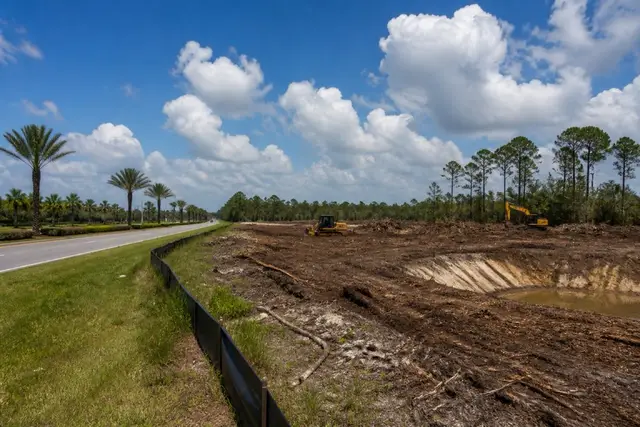
Flagler Clearing Pros connects Palm Coast property owners with a local land clearing contractor for commercial site clearing in Palm Coast and the Flagler County communities around it.
Palm Coast's growth arithmetic is simple: one of Florida's fastest-growing corners keeps needing shopping centers, storage, medical space, and multifamily ground, and each of those projects begins the same way: acres of flatwoods coming off. Commercial site clearing is that first act at production scale — dozers, excavators, mulchers, and haul trucks converting a wooded parcel into a workable site while the paperwork that governs the parcel stays satisfied.
Scale changes the compliance weight, not the physics. A commercial clearing operates inside a development order: tree surveys and preservation requirements from the local code, stormwater and erosion control obligations that begin the day the first machine cuts, and wildlife surveys — gopher tortoise above all in this sandy county — completed and permitted before the ground is disturbed. On multi-acre parcels those burrow counts routinely reach the permit tier that requires authorized relocation before clearing.
Execution is logistics. The site gets sequenced so debris streams stay separated — merchantable pine one way, grindable brush another, grubbed stumps and organics a third — with windrows placed for the loaders, silt fence and inlet protection installed at the perimeter first, and truck routing planned so a hundred loads don't destroy the public street's edge. Weather windows get respected because a big site opened at the wrong moment sheds sand with every storm.
For the developer's schedule, the clearing contractor is either the first hero or the first excuse. The difference is usually preparation: the outfit that walked the parcel, took the survey and permit set seriously, and priced real conditions delivers a pad-ready site on the date its schedule promised.
The permit stack that precedes the first machine
Commercial clearing in this market answers to several documents at once: the development order and its landscape-preservation conditions under the city's land development code, state stormwater permitting with its erosion-control obligations, and the wildlife layer — where the FWC's gopher tortoise permit tiers scale with burrow count and can require relocation by authorized agents before disturbance. None of it is exotic; all of it is sequence-critical, because a violation discovered mid-clear stops the whole site, not just the offending corner.
The clearing contractor's role is fit: knowing which trees the approved plan preserves, where the tortoise fencing stands, and which perimeter goes silt-fence-first.
Debris economics at commercial scale
On a quarter-acre lot, debris handling is a line item; on twenty acres it's the budget's swing factor. Standing slash pine may carry pulpwood value that offsets cost when a timber buyer is arranged before the cut. Brush and understory grind cheapest on site, and the mulch either stages for reuse in landscape buffers or hauls as the plan requires. Grubbed stumps and root mats — the unburnable, unsellable fraction — cost the most per ton to move, which is why minimizing how much ground actually gets grubbed, versus mulched, is a real design decision.
Burning at scale is sometimes permitted for land-clearing debris under Florida Forest Service authorization with air-curtain equipment and setbacks, but many Palm Coast-area sites sit too close to neighbors for it to be worth the friction — grinding has largely won this market.