 Flagler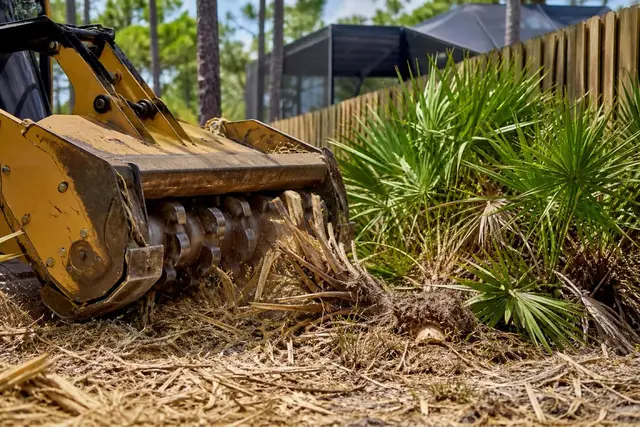
Flagler Clearing Pros connects Palm Coast property owners with a local land clearing contractor for palmetto removal in Palm Coast and the Flagler County communities around it.
If Palm Coast has one signature clearing job, this is it. Saw palmetto carpets the flatwoods that this city was platted into, and every wooded lot, deep backyard, and fence line carries its share of fans, sprawling trunks, and interlocked root crowns. Getting rid of it properly is a different task from mowing it, and the difference is exactly where most cheap jobs go wrong.
The plant is built to survive removal attempts. Its stem creeps along or under the ground, the growing point tucked safely inside, and a blade that takes the fans off at ankle height leaves that stem entirely alive. The regrowth arrives the same season. Real removal means extracting or grinding the crowns and running roots themselves — machine work with a grapple, root rake, or deep-set mulcher head, followed by raking the sand clean of debris.
How deep to go depends on what the ground becomes next. For a lawn conversion or a future slab, crowns come out entirely and the sand gets raked and graded. For a natural-look understory where you just want walking room, grinding to grade and accepting slow, sparse regrowth is cheaper and gentler on the site. Both are legitimate outcomes; a written quote should say plainly which one it prices.
One caution born of local ground: palmetto thicket is favorite cover for gopher tortoise burrows, and those burrows are protected by Florida rule whether or not anyone knew they were there. A pre-job walk that finds and flags burrow aprons keeps the machine 25 feet clear and keeps the project on the right side of the state.
Why palmetto always comes back from a surface cut
Saw palmetto (Serenoa repens) is one of the most fire-adapted plants in the Southeast — the same architecture that lets it resprout days after a prescribed burn lets it laugh at a mower. Its trunk usually runs horizontally at or below the sand surface, and the bud that produces new fronds rides inside that trunk, out of any blade's reach. UF/IFAS extension publications document both the species' resilience and its ecological value, which is why complete eradication is a deliberate choice, not a default.
The practical rule: whatever the quote calls "palmetto removal" should specify crown extraction or sub-grade grinding. If it only prices cutting, you are buying this year's appearance, not the outcome.
What removal does to the sand, and how the lot recovers
Pulling root crowns disturbs the top foot of soil, and on this county's loose gray sand that means a brief window where wind and thunderstorm runoff can move material around. The fix is standard practice: rough-grade the disturbance the same week, keep the swale line clear so water leaves the lot the way the city intended, and get ground cover established quickly. Sod, seed, or a mulch dressing all work; bare sand through a full Northeast Florida summer does not.
Owners converting palmetto ground to lawn should budget for soil amendment — decades of palmetto litter leave acidic, low-nutrient sand, and IFAS lawn-establishment guidance is the reference worth reading before the sod order.